News
From workflows to a new culture of training and collaboration
ODISSEE Annual Consortium Meeting
In January 2026, the ODISSEE consortium met at CERN for three days of scientific exchanges and strategic discussions, including sessions on radio astronomy, particle physics, and dark matter research, as well as a visit to the LHCb experiment. The partners also refined their common roadmap for the coming months, with new hackathons aimed at further strengthening collaboration between the various partners, scientists, engineers, and industrialists.
This meeting marks an important milestone: the project validated the deployment of an end-to-end workflow on the SKAO use case. ODISSEE has coupled OSKAR, the digital twin of the future SKAO data capture system, deployed at scale, with a complete data processing pipeline (replay of the webinar), including calibration and imaging. On top of this, ODISSEE partners have complemented OSKAR by adding more realistic components, including simulated astronomical objects and perturbations such as thermal noise and ionospheric disturbances. Once the digital twin is connected to the data processing workflow, teams can explore how advanced algorithms perform, including artificial intelligence techniques. Moreover, thanks to the implementation of more realistic digital twins of their experiment, they will be able to train more efficiently new deep neural networks to improve sensibility, resolution and energy efficiency.
This experiment was carried out at large scale on the French Jean Zay supercomputer, using the BSC orchestration tool, PyCOMPSs, which was integrated with the radio-interferometry workflow for the purpose of this experiment. It will also represent an opportunity to test and validate new European technologies such as those developed by SiPearl and NextSilicon in the near future. Similar end-to-end workflows have also been deployed for CERN’s LHCb experiment, where new hardware and energy monitoring tools are currently being evaluated.
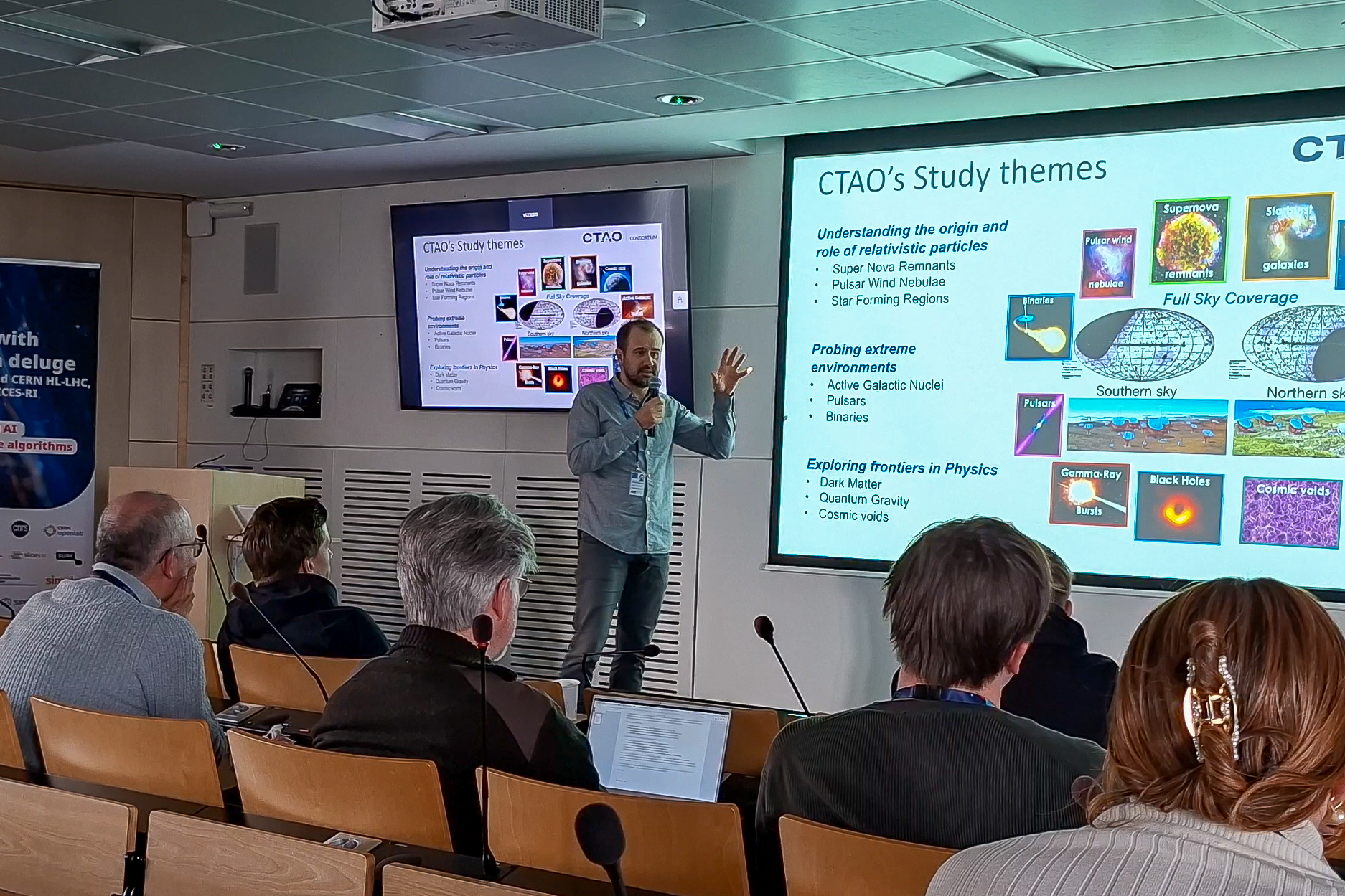
« All the solutions, software, and hardware that ODISSEE can help us find would be extremely useful. »
Matthieu Heller, Deputy Coordinator of the CTAO, and Lecturer and Researcher at the University of Geneva
Training and technology transfer are at the heart of this approach. ODISSEE is currently designing a unique experimental platform to this end, coordinated by Inria, bringing together experts from various domains and leveraging this end-to-end massive data processing workflow for testing and educational purposes and to be deployed on the long term on SLICES-RI.
This platform will enable, on the one hand, scientists and research infrastructures staff to be trained in the same technical environment that is used to process scientific data and, on the other hand, engineers and developers of the various ODISSEE contributions to understand how to better foster usage of their new solutions and products. In this context, for instance, EAR engineers and researchers will be able to demonstrate the impact of the technology they develop in optimizing the energy efficiency of supercomputers on a real use case.
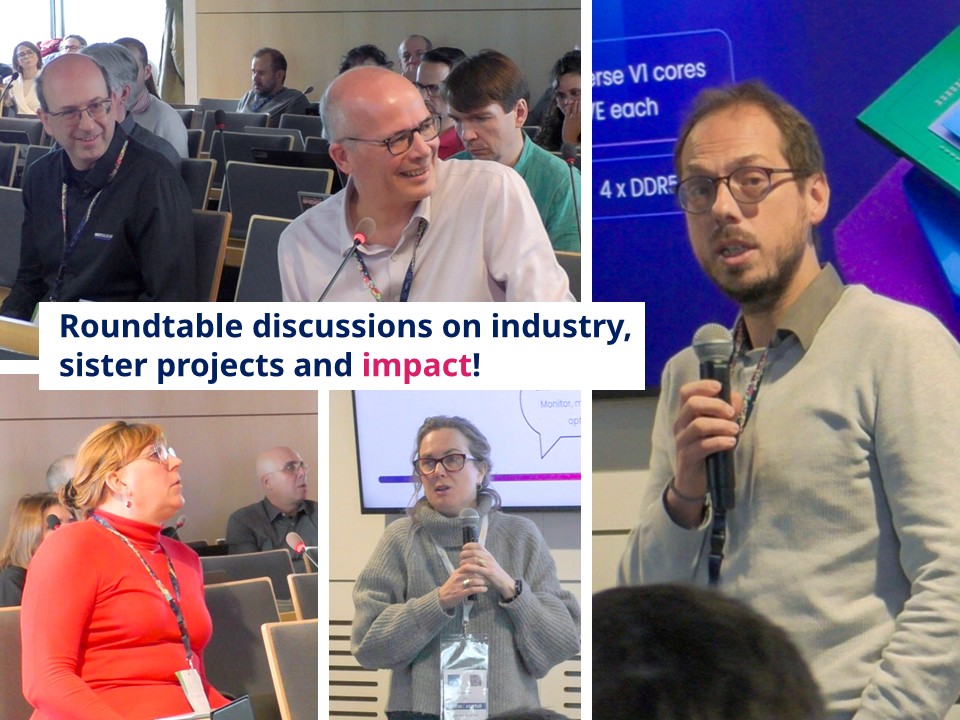
Large scientific infrastructures such as SKAO and CERN’s LHCb are entering an era where scientific discoveries are no longer limited only by hardware performance, but also by our ability to process and analyze unprecedented volumes of data. The ODISSEE project is addressing this challenge not only by developing and testing new solutions covering the digital continuum, but also by designing new training for scientists and engineers on how to use them efficiently.
Watch the replay of all scientific presentations on the CERN openlab website
News and events
Follow us

ODISSEE Webinar: How can we assess the AI and HPC environmental and societal impacts?
Join us for a 45-minute webinar ! Generative AI and Agentic AI are revolutionizing the way we consume digital services, specially in High...
ODISSEE GPU Hackathon – Bordeaux, 12 to 15 October 2026
The next ODISSEE GPU Hackathon will take place in Bordeaux from 12 to 15 October, bringing together project partners and technical experts to...
First ODISSEE hackathon: Exploring sustainable computing for next-generation radio astronomy
Could you briefly introduce yourself and ASTRON? My name is Chris Broekema. I am a researcher in high-performance computing at ASTRON, the...