Interview with Etienne Renault, R&D Computer Science Manager at Sipearl
How can we help to build sovereignty in Europe
In this interview, Etienne Renault from SiPearl discusses the importance of European technological sovereignty and SiPearl's involvement in the ODISSEE project. The interview also covers the technical challenges of achieving maximum performance and energy efficiency, and the wider implications of their work for European industrial collaboration.
Can you introduce yourself?
Hi, I’m Etienne Renault. I lead the Performance team at SiPearl, the European company designing high-performance, low-power microprocessors for supercomputing. My work covers everything from Linux kernel and low-level toolchains to AI and HPC benchmarking, ensuring SiPearl’s CPUs deliver maximum performance.
I joined SiPearl mainly because Europe needs sovereignty, and the ability to build a CPU dedicated to high performance and AI is a key driver for European sovereignty.
Can you tell us about the role of SiPearl in the ODISSEE project and how your expertise is contributing to the project?
SiPearl will provide prototypes to the partners based on the Rhea processor. To achieve maximum performance, close co-design between software and SiPearl hardware is essential. By leveraging both, SiPearl will drive sustainability, energy efficiency and sovereignty for ODISSEE.
What are the main technical challenges to be overcome in the ODISSEE project from your point of view?
The main technical challenge will be to ensure maximum performance and energy efficiency. This requires significant work to co-design the software stack to push memory bandwidth, I/O throughput, and compute density to the limit.
Can you explain how the technologies developed by SiPearl are being integrated into the ODISSEE project?
SiPearl will be involved in several work packages to make the most of its CPUs. WP3 focuses on improving the co-design of the software stack to ensure efficient AI power management. WP4 aims to optimise the software stack (programming models, runtimes, AI/HPC frameworks) for greater efficiency on SiPearl hardware. WP5 addresses scalability in use-case workflows to optimally exploit different classes of heterogeneous memory.
« Europe needs sovereignty, and the ability to build a CPU dedicated to high performance and AI is a key driver for European sovereignty. »
« SiPearl will provide prototypes to the partners based on the Rhea processor. »
How can the technologies developed as part of the ODISSEE project benefit other industrial players in Europe?
Technologies developed at SiPearl will be a key driver of European sovereignty. Each project using SiPearl chips creates a new vertical, and together all these verticals require hardware/software co-design. These co-design efforts require strong and long-term collaboration in order to influence future generations of processors.
What advice would you give to companies wishing to take part in collaborative research projects such as ODISSEE?
As an industrial partner and as a hardware provider, our role is to ensure we meet end-user requirements and provide the best performance, while ensuring interoperability and facilitating adoption. Collaborative projects are a unique opportunity to reach this objective.
Generally, collaborative projects strengthen cooperation and cross-fertilisation between academics and industry players, for the benefit of research, the leveraging of our European IP and the commercialisation of new technologies and products to build sovereign solutions for Europe and reduce external dependency.
News and events
Follow us

ODISSEE Webinar: How can we assess the AI and HPC environmental and societal impacts?
Join us for a 45-minute webinar ! Generative AI and Agentic AI are revolutionizing the way we consume digital services, specially in High...
ODISSEE GPU Hackathon – Bordeaux, 12 to 15 October 2026
The next ODISSEE GPU Hackathon will take place in Bordeaux from 12 to 15 October, bringing together project partners and technical experts to...
First ODISSEE hackathon: Exploring sustainable computing for next-generation radio astronomy
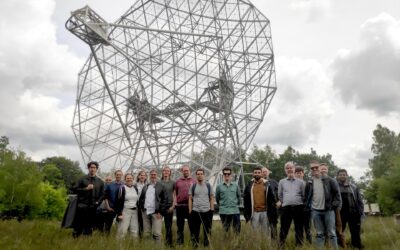
Could you briefly introduce yourself and ASTRON? My name is Chris Broekema. I am a researcher in high-performance computing at ASTRON, the...