Interview with Etienne Bonnassieux, research engineer at the University of Bordeaux
Building the Foundations of Next-Generation Radio Astronomy Data Processing
In this interview, Etienne shares how his work on the radio-astronomy pipeline aims to make it scalable and usable across major international radio telescope facilities such the future SKAO.
Could you describe your role in the ODISSEE project?
The project aims to build a software package able to handle data processing workflows in the modern scientific landscape, which is characterised by overwhelming data volumes. One of the case studies is the SKAO. In this context, I am working to document and standardise our radio telescope data processing pipeline, which handles three data domains: sky distribution, antenna gains, and the measurements themselves.
My work will ensure that our pipeline can be used by other research infrastructures, by clarifying data formats and inputs/outputs, and by ensuring its interoperability with international standards – which often involves defining them! In this way, ODISSEE is already shaping, directly and measurably, the future of radio astronomy.
How is this pipeline organised?
A radio telescope measures sky brightness distributions (maps of the sky) indirectly. Furthermore, this indirect measurement is corrupted by a variety of effects, which can be astrophysical in nature (propagation effects such as Faraday rotation) or result from our instrumental hardware itself. These effects are measured along with the sky signal. Our processing aims to separate these contributions. In a radio astronomy data processing pipeline, there are thus three ‘boxes’ – SKY, MEASURE and ANTS – which separate the signal from the sky itself, its propagation effects, and our measurement space, in order to better correct the measurements and reconstruct the final image of the sky.
Astrophysical and instrumental propagation effects are modelled as antenna-based effects; we seek an estimate of the ANTS parameters from the measured data, then correct the observations to reconstruct SKY as best as we can.
« ODISSEE is already shaping, directly and measurably, the future of radio astronomy. »
Using this reconstruction of SKY, we then attempt to improve our estimates of the ANTS parameters, which will further improve our reconstruction of SKY. Once we are satisfied with our final ANTS and SKY estimates, which must represent our actual measurements as accurately as possible, we have produced our final scientific outputs: the sky map will complement those taken in other bands (optical, X-rays, etc.) according to the scientific interests of astronomers and researchers. The ANTS models enable us to study solar activity and the impact of solar flares on Earth, but also to better understand our instrument itself.
For the pipeline to function consistently, these data sets must be able to ‘communicate’ with one another, meaning that they must be formatted in such a way that each stage of processing can read and exploit them unambiguously.
What exactly does this clarification of formats you mentioned involve?
The initial DDFacet processing pipeline was developed by Cyril Tasse, an astronomer at the Paris Observatory, as part of his research work. Together with ODISSEE, he undertook a massive collaborative effort that allowed us to meet the data volume challenge. However, the pipelines remains a research work at present – to be adopted by other scientists and their infrastructures, there is a lot of groundwork to be done!
The first challenge is the lack of documentation and standardisation in the existing codebase, whose development emphasis was placed on the implementation and optimisation of new, cutting-edge features. As one of the first users of this software, I am coordinating the work to formalise and streamline the codebase. In practical terms, I analyse the existing code to understand exactly what each function does and when. Next, I define strict data formats that allow data and metadata to be stored as clearly as possible. Finally, I rewrite or adapt the code to use these formats, and I document each step so that users know exactly how to interact with the pipeline.
« I document each step so that users know exactly how to interact with the pipeline. »
« Our current goals is to ensure that future user infrastructures using this code have a clear and well-documented interface. »
My role as an engineer involves ‘tightening the screws’ where development standards were not adhered to, due to the pressure to meet technical deadlines. We aim to move from a research tool to an fully institutional product, much like moving from a Formula 1 car to a robust and reliable mass-produced vehicle that anyone can use without being a mechanic or an expert; our challenge is to do this while preserving the technical characteristics of the original tool.
In practice, our current goals is to ensure that future user infrastructures using this code have a clear and well-documented interface, which we are in the process of creating. This involves defining explicit schemas so that any collaborator knows exactly what is contained within the object, how to manipulate and visualise it, without needing an intermediary from our team. I am therefore working closely with partners, such as Simon Perkins from SARAO in South Africa, to ensure that our data formats also meet the needs of SKA precursors such as MeerKAT in South Africa, as well as the uGMRT in India, the ILT in Europe, and the VLA in the United States.
You started out as an astronomer and now you work with code. Is that more exciting?
I personally feel that my work is still fundamentally driven by astronomy itself : I want to fully understand the measurement and instrument to validate my understanding of the sky. In a sense, this is a bit like working as a line cook in the kitchen, to make sure that the dishes we serve are prepared to the highest standards. It only motivates me to eventually enjoy the meal !
My aim is to make this pipeline a recognised standard, used by research infrastructures around the world. If we succeed, researchers will be able to focus on scientific analysis without worrying about technical challenges.
Personally, I see this collaboration as an exceptionally effective dynamic, where everyone lifts each other up. I have rarely experienced such synergy between teams. Much of this effectiveness comes from Damien Gratadour, who knows how to motivate and challenge the teams, but it’s not just him: it’s also a team of competent, well-positioned and deeply motivated people.
« My aim is to make this pipeline a recognised standard, used by research infrastructures around the world. »
News and events
Follow us

ODISSEE Webinar: How can we assess the AI and HPC environmental and societal impacts?
Join us for a 45-minute webinar ! Generative AI and Agentic AI are revolutionizing the way we consume digital services, specially in High...
ODISSEE GPU Hackathon – Bordeaux, 12 to 15 October 2026
The next ODISSEE GPU Hackathon will take place in Bordeaux from 12 to 15 October, bringing together project partners and technical experts to...
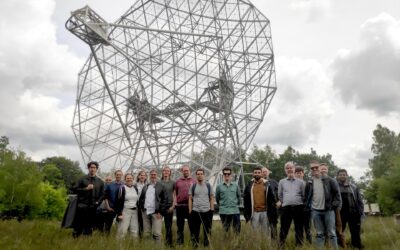
First ODISSEE hackathon: Exploring sustainable computing for next-generation radio astronomy
Could you briefly introduce yourself and ASTRON? My name is Chris Broekema. I am a researcher in high-performance computing at ASTRON, the...