Interview with James Trotter, Research Scientist at Simula
Adapting Research Software to Next-Generation Hardware
In this interview, James discusses how ODISSEE is adapting scientific software to next-generation hardware for more efficient and sustainable data-intensive science.
Could you briefly introduce yourself and Simula?
My name is James Trotter. I am a research scientist at Simula, a research laboratory based in Oslo, Norway. Simula conducts research in information and communication technology (ICT), and I work in a group focused on high-performance computing.
In my daily work, I write scientific software and study how it behaves on large computing systems. I work especially on software for high-performance computing, which require specialised programming approaches and support scientific applications across many domains.
What is the main computing challenge addressed in ODISSEE?
Both radio astronomy and high-energy physics are new topics for me. They present particularly demanding software challenges because their instruments generate data at very high rates and in enormous volumes.
Future research infrastructures must process this data while reducing energy consumption. Simply purchasing newer hardware will not be enough: although it may be more energy efficient, existing scientific software cannot automatically take advantage of it.
We need to adapt, modify and modernise software so that it can run efficiently on new types of machines. This is especially important for experimental hardware and emerging architectures, which may offer significant potential but require specific programming approaches.
ODISSEE addresses this challenge through a hardware proof of concept that combines experimental European technologies with a broad range of existing computing platforms. The aim is not to identify a single universal solution, but to evaluate which combinations of processors, accelerators, memory and networking technologies are best suited to the workloads of radio astronomy and high-energy physics.
« We need to adapt, modify and modernise software so that it can run efficiently on new types of machines. »
« Our role is to help researchers modernise their software and hardware usage. »
How does Simula contribute to addressing this challenge?
In ODISSEE, much of the work is led by domain scientists who understand the software, workflows and processing needs of their communities. Simula supports them from the high-performance computing side. Our role is to help researchers modernise their software and hardware usage. This includes supporting software development, helping partners understand how to program for new machines, and making novel hardware available to the consortium.
We are contributing to the technical design and description of the ODISSEE proof-of-concept hardware. The proof of concept brings together three complementary levels of computing resources. The experimental level focuses on novel European technologies, particularly the SiPearl Rhea ARM-based processor and the NextSilicon Maverick-2 accelerator. One of Simula’s key contributions is providing access to these unique hardwares. The small-scale level provides access to a heterogeneous collection of CPUs, GPUs, FPGAs and other accelerators for software development and comparative evaluation. The scale-out level allows us to test the solutions on large supercomputers.
This range is important because the requirements of the two use cases are broad. The software must support multiple codebases, interoperability between components, simulator integration, sequential and pipelined execution, and different compute and networking technologies. A modular approach is therefore essential.
ODISSEE also focuses strongly on energy efficiency. What does this mean in practice?
In ODISSEE, one of the main objectives is to reduce the energy consumption of computing systems, making it essential to map current usage. The more we understand how much power existing software and hardware require, the better we can identify opportunities for improvement. Several partners in the project already have tools and experience for monitoring resource use across different computing workloads. In ODISSEE, we are applying this expertise specifically to radio astronomy and high-energy physics workloads.
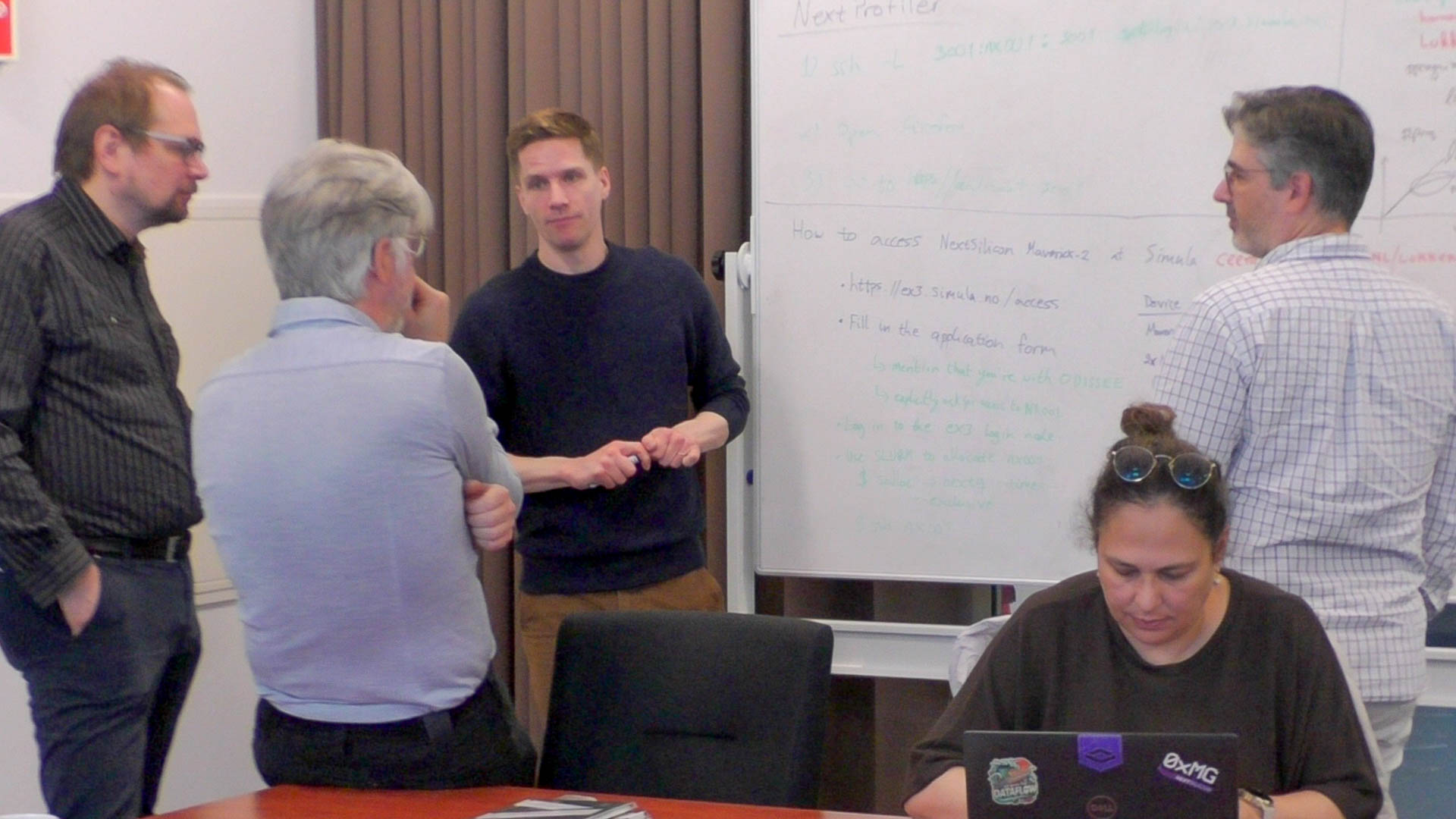
ODISSEE Hackathon organized by Astron in Dwingeloo
What perspectives does Simula envisage for the remainder of the project?
The project’s technical design work is deliberately being developed as a concept that can evolve. The initial deliverables describe the available hardware, the requirements, the comparison systems, the energy-monitoring infrastructure and the risks associated with evaluating novel technologies. Later work will add measurements, application results and studies of relative environmental impact.
In the long term, this contributes to more sustainable research infrastructures. For Simula, the project is an opportunity to bring HPC expertise, hardware access and experience with novel architectures to scientific communities working on some of the most exciting experiments in Europe, including SKAO and LHCb. Supporting these communities with more efficient, portable and energy-aware computing is a valuable contribution to the future of data-intensive science.
« In the long term, this contributes to more sustainable research infrastructures. »
News and events
Follow us

ODISSEE Webinar: How can we assess the AI and HPC environmental and societal impacts?
Join us for a 45-minute webinar ! Generative AI and Agentic AI are revolutionizing the way we consume digital services, specially in High...
ODISSEE GPU Hackathon – Bordeaux, 12 to 15 October 2026
The next ODISSEE GPU Hackathon will take place in Bordeaux from 12 to 15 October, bringing together project partners and technical experts to...
First ODISSEE hackathon: Exploring sustainable computing for next-generation radio astronomy
Could you briefly introduce yourself and ASTRON? My name is Chris Broekema. I am a researcher in high-performance computing at ASTRON, the...