Hackathon in Oxford with Yassine Msilini from the ODISSEE project
In Oxford, ODISSEE helps accelerate radio astronomy data-processing pipelines
In May 2026, ODISSEE took part in an international hackathon in Oxford focused on accelerating radio astronomy data-processing pipelines.
Modern radio astronomy pipelines are approaching a critical scalability threshold. Instruments such as MeerKAT already produce datasets that push existing calibration and imaging workflows to their limits, while the future Square Kilometre Array Observatory (SKAO) will increase both data volumes and computational demands by orders of magnitude. Accelerating and optimising these software pipelines has therefore become a key challenge for the scientific community, requiring new approaches in high-performance computing, GPU acceleration and algorithm design.
In this context, an international hackathon was held in Oxford in May 2026, organised by the Department of Physics at the University of Oxford in collaboration with contributors to the Tron-PFB pipeline, and bringing together specialists in radio astronomy, high-performance computing and scientific software development. Participants included South African teams working with Oleg Smirnov of the South African Radio Astronomy Observatory (SARAO), representatives from EPFL, and Yassine Msilini, CNRS Research Engineer at LAB, funded by the ODISSEE project.
The goal of the week was clear: to improve, stabilise and accelerate data-processing pipelines for radio astronomy, particularly those used for imaging and transient detection from data produced by large instruments such as MeerKAT. “The pipeline works, but it is still in a research and implementation phase,” Yassine explains. “If you give it a dataset, it runs. But it can be improved: it needs to become more robust, better documented and more user-friendly.”
Optimising processing chains for a new scale of data
Modern radio telescopes do not directly produce images of the sky. They generate vast quantities of complex data, known as visibilities, which must then be calibrated, corrected and transformed through specialised software chains. As instruments become more sensitive and include more antennas, these processing tasks become increasingly demanding in terms of computing time.
This is where ODISSEE brings strategic expertise: GPU optimisation of complex scientific codes. During the hackathon, Yassine contributed to profiling the pipeline in order to identify the most compute-intensive sections and assess which parts would benefit most from GPU acceleration. “We had a real profiling phase to determine whether it made sense to port parts of the code to GPU, and which ones,” he says.
The work focused on critical imaging and convolution functions. Yassine developed several GPU kernel prototypes and achieved promising results, including an approximately 30x speed-up on a uniform convolution operation. These early results highlight the potential of GPU acceleration for key stages of radio astronomy data processing.
A technical and strategic contribution for ODISSEE
Beyond the immediate technical contribution, ODISSEE’s participation in the hackathon provided an opportunity to showcase the project’s ongoing work on calibration and GPU optimisation. Yassine’s core work within ODISSEE focuses on another essential component of processing chains: calibration.
In radio astronomy, each antenna introduces distortions caused by instrumental, electronic or atmospheric effects. Without correction, the reconstructed image of the sky may be blurred or corrupted. Calibration estimates and corrects these distortions to produce scientifically usable images. “If we image without correcting this, we get a poor image quality. This is where calibration comes in, in order to improve resolution and sensitivity” Yassine says.
Within ODISSEE, teams are working on rewriting a calibration software base adapted to GPU architectures and to the future requirements of major instruments, particularly SKA-Mid. The aim is to reduce processing times and move towards faster, potentially near-real-time processing depending on the use case. “We are aiming for a first prototype before the end of the year,” Yassine notes. “The idea is to have a clean, documented and usable tool, with solvers running on GPU.”
This perspective attracted strong interest among hackathon participants. Yassine presented ODISSEE’s work on GPU-based calibration and discussed future experiments with international actors involved in MeerKAT and SKA pipelines.
« The pipeline works, but it is still in a research and implementation phase. If you give it a dataset, it runs. But it can be improved: it needs to become more robust, better documented and more user-friendly. »
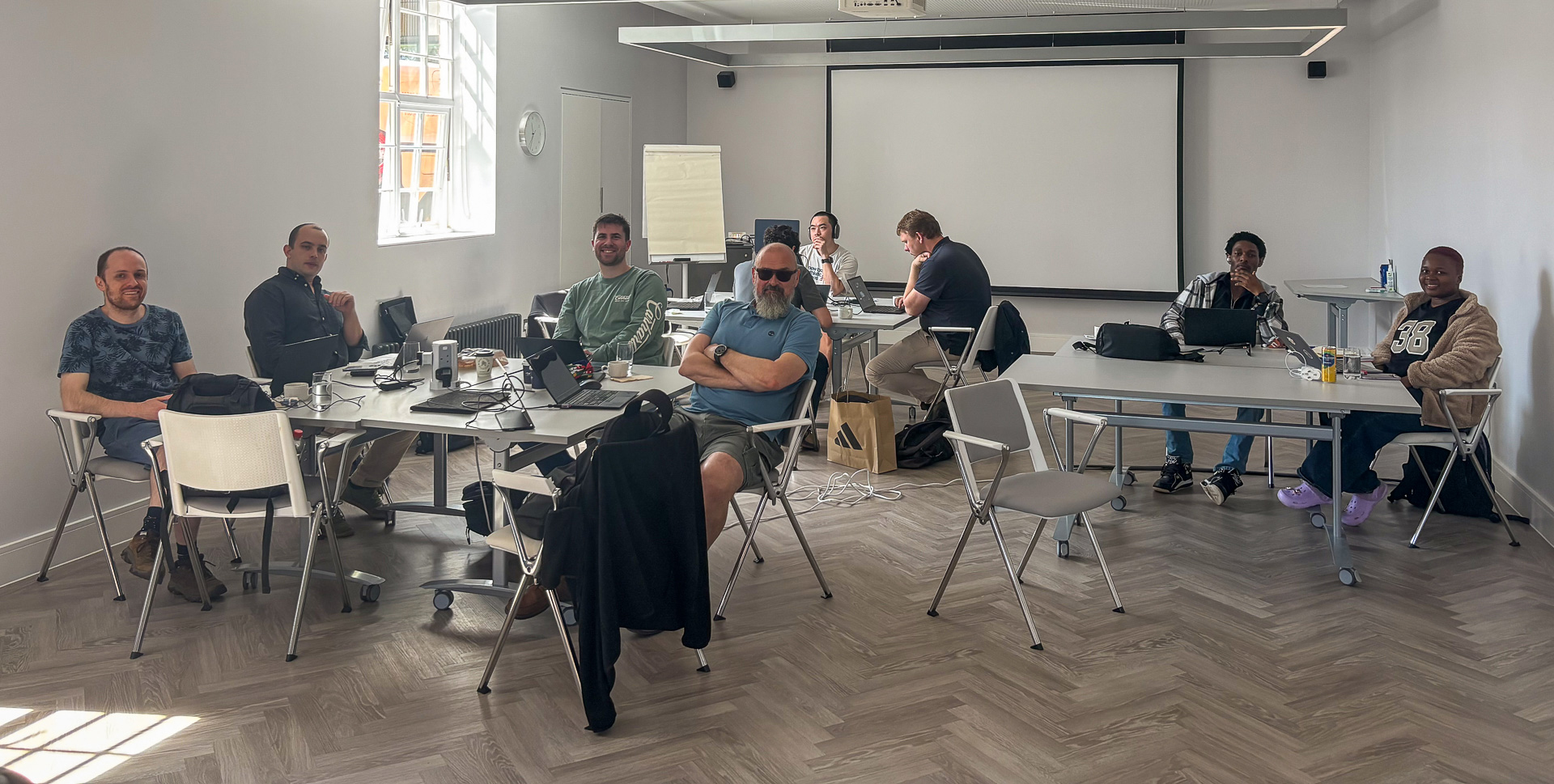
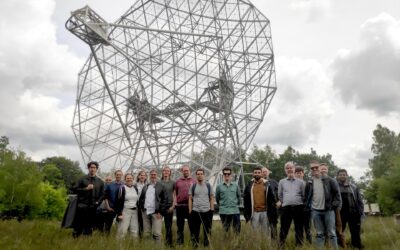
Hackathon organized by the Department of Physics at the University of Oxford, with participants from EPFL, SARAO, and CNRS, May 2026. Photo: Yassine Msilini
« We are aiming for a first prototype before the end of the year. »
Building bridges between scientific and software communities
The week in Oxford also provided an opportunity to exchange ideas with researchers and engineers working on similar challenges. Yassine’s presence helped showcase ODISSEE’s work to South African, Swiss and international teams involved in large-scale data processing, radio imaging and calibration.
These interactions are expected to strengthen future collaborations around MeerKAT, SKA and other next-generation radio telescopes. The hackathon highlighted the value of combining expertise in astronomy, software engineering and high-performance computing to tackle the growing data volumes produced by modern observatories.
By contributing its GPU expertise, ODISSEE is helping develop faster and more efficient processing tools while reinforcing international partnerships that will be essential for the future of radio astronomy.
News and events
Follow us
ODISSEE GPU Hackathon
The next ODISSEE GPU Hackathon will take place in Bordeaux from 12 to 15 October, bringing together project partners and technical experts to...
First ODISSEE hackathon: Exploring sustainable computing for next-generation radio astronomy
Could you briefly introduce yourself and ASTRON? My name is Chris Broekema. I am a researcher in high-performance computing at ASTRON, the...

ODISSEE Webinar: Optimizing AI Workflows on HPC – From Hyperparameter Tuning to Scientific Use Case Integration
Join us for a 60-minute webinar ! Modern AI development increasingly depends on efficient, scalable workflows that can take full advantage of...